
In the last few years, remote proctoring has moved from being a backup option for testing to becoming a mainstream necessity. With the rapid adoption of online education, skills-based assessments, corporate certifications, and large-scale recruitment exams, institutions and organizations worldwide are relying on proctoring platforms to ensure fairness, security, and integrity in their evaluation processes.
But the landscape is shifting again. With the rise of Large Language Models (LLMs) such as GPT-4 and beyond, remote proctoring systems are entering a new era — one where AI can not only detect misconduct but also make intelligent, contextual decisions, provide personalized support, and transform the entire assessment experience.
The State Of Remote Proctoring Today
Traditional remote proctoring relies on a combination of:
- Live Proctoring: Human invigilators monitoring via webcam.
- Recorded Proctoring: Reviewing video and audio recordings post-exam.
- AI-Based Proctoring: Using algorithms for facial recognition, eye movement detection, browser lockdowns, and environmental scans.
While effective, these systems face challenges:
- High false positives due to rigid AI rules.
- Test anxiety caused by excessive surveillance.
- Limited adaptability across diverse cultural or accessibility contexts.
- Concerns about data privacy and transparency.
This is where LLMs are stepping in to transform the game.
How LLMs Are Reshaping Proctoring Systems
1. Contextual Understanding Of Test-Taker Behavior
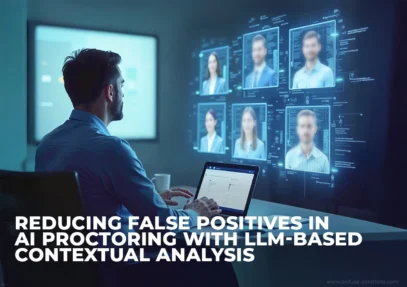
Unlike conventional AI that flags any “unusual” movement as suspicious, LLMs can interpret behavior more intelligently.
For example, if a candidate mutters a question aloud, a basic system may flag it as potential cheating. An LLM-powered system, however, can analyze context — distinguishing between harmless self-talk and genuine attempts to communicate externally.
This ability to reduce false positives makes the proctoring process more accurate and less stressful for candidates.
2. Real-Time Conversational Support During Assessments
Proctoring systems traditionally focus only on catching malpractice. But LLMs enable a dual role: security plus support.
LLMs can act as an intelligent chatbot within the exam environment, assisting candidates with:
- Clarifying exam instructions without revealing answers.
- Helping troubleshoot technical issues like connectivity drops.
- Guiding accessibility needs, such as adjusting screen contrast for visually impaired users.
This creates a smoother and more human-like experience while ensuring assessments remain fair.
3. Enhanced Voice And Text Analysis
Many cheating attempts involve covert communication through whispers or hidden messaging apps. Large Language Models (LLMs) can process both speech and text patterns with far greater accuracy than traditional systems.
For instance:
- Identifying unusual phrasing in candidate responses that may have been copied from external sources.
- Detecting backchannel conversations in the background using natural language cues.
- Differentiating between genuine test-taking behavior and scripted responses.
This advanced linguistic capability strengthens fraud detection without relying solely on invasive surveillance.
4. Personalized Security Protocols
Not all exams carry the same stakes. A corporate compliance quiz may require lighter monitoring compared to a high-stakes government licensing exam.
LLMs make it possible to dynamically adapt proctoring intensity:
- Lower Stakes: minimal interventions, more trust-based monitoring.
- High Stakes: layered security, including advanced anomaly detection and identity verification.
By customizing proctoring strategies, institutions can balance fairness, user comfort, and data security.
5. Automated Reporting And Insights
One of the most time-consuming aspects of remote proctoring is the manual review of flagged cases. LLMs can generate comprehensive, human-readable reports that include:
- Summary of potential violations with contextual explanations.
- Behavioral patterns over the course of the exam.
- Recommendations for human review or next steps.
These reports reduce workload for administrators and ensure decisions are backed by transparent, data-driven insights.
6. Cross-Language And Cultural Adaptability
Global assessments face the challenge of diverse test-taker populations. What may appear suspicious in one cultural context could be completely normal in another.
LLMs trained on multilingual, multicultural datasets can interpret behaviors more fairly, reducing bias in proctoring decisions. Additionally, they allow candidates to interact with exam platforms in their native language, improving accessibility and inclusivity.
Opportunities And Benefits
- Fairer Assessments: Reduced false positives and bias create a more level playing field.
- Scalability: With AI handling initial analysis, human proctors can focus only on complex cases.
- Enhanced Candidate Experience: Less intrusive monitoring and real-time assistance lower stress.
- Stronger Fraud Prevention: More nuanced detection of misconduct beyond rigid rule-based systems.
- Data-Driven Decision Making: Institutions gain richer insights into candidate behavior and exam performance.
Challenges To Consider
As promising as LLM-powered proctoring sounds, challenges remain:
- Privacy Concerns: Candidates may feel uneasy about advanced AI analyzing behavior and speech.
- Ethical Boundaries: Clear guidelines must ensure AI does not cross into over-surveillance.
- Bias in Training Data: If not carefully trained, LLMs can perpetuate existing biases in exam monitoring.
- Transparency: Institutions must communicate how AI decisions are made to maintain trust.
Addressing these concerns is crucial to creating a system that is both effective and ethical.
The Future Of LLMs In Proctoring
We are just scratching the surface of how LLMs will transform proctoring. Future innovations may include:
- Emotion-aware proctoring to differentiate stress from misconduct.
- Proctoring-as-a-service platforms integrated into global skills marketplaces.
- Blockchain-backed credentialing combined with LLM-powered monitoring to ensure secure, tamper-proof certifications.
- Agentic AI proctors capable of autonomously managing assessments end-to-end — from setup and monitoring to reporting and follow-up.
The convergence of LLMs with other technologies like computer vision, biometrics, and IoT devices will pave the way for an ecosystem where assessments are not only secure but also adaptive, accessible, and learner-friendly.
EnFuse Solutions: Enabling The Next Wave Of Secure Assessments
At EnFuse Solutions, we recognize that the future of assessments lies in balancing integrity with inclusivity. Our remote proctoring solutions integrate advanced AI — including natural language processing and machine learning models — to help organizations securely scale their skills-based assessments.
From real-time monitoring and fraud detection to seamless integration with LMS and HR systems, we provide a compliance-first, candidate-friendly approach. With the evolution of LLMs, we are exploring new frontiers in contextual proctoring, multilingual support, and intelligent reporting — ensuring our clients stay ahead in the digital assessment landscape.
Conclusion
Remote proctoring is no longer just about surveillance; it’s about creating trustworthy, accessible, and scalable assessment ecosystems. Large Language Models are ushering in a new era where AI doesn’t just monitor but understands, adapts, and supports both institutions and test-takers.
As organizations continue to prioritize skills verification in education, recruitment, and professional development, LLM-driven proctoring systems will become central to ensuring fairness, accuracy, and efficiency. The next generation of proctoring won’t just stop cheating — it will empower authentic learning and talent recognition at scale.
Tags