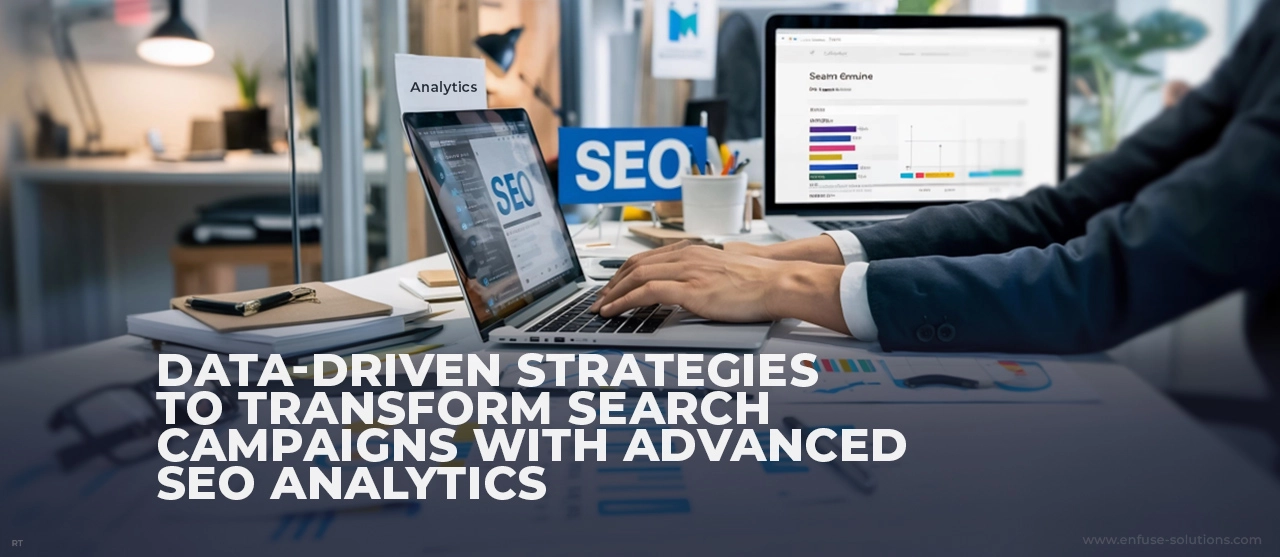
Search is no longer just about rankings. What started as keyword optimization has evolved into something far more complex – understanding intent, entities, and how both humans and AI perceive your brand.
In today’s AI-driven search landscape, success isn’t measured by impressions alone. It’s measured by visibility across systems, influence on decision-making, and contribution to revenue.
At EnFuse Solutions Ltd., we see SEO evolving into a data-led discipline where analytics is no longer descriptive, but predictive and strategic.
Here are the key data-driven strategies redefining modern search performance.
1. Generative Engine Optimization (GEO) & AI Visibility
Search is no longer limited to “blue links.”
With the rise of AI platforms like ChatGPT, Gemini, and Perplexity AI, visibility now includes being cited, summarized, and recommended by AI systems.
New Strategy:
Track how often your content appears as a source in AI-generated responses, not just how it ranks.
Actionable Insight:
Measure AI Citation Rate and “Citations per Query” to understand:
- Where your brand is being referenced
- Whether it’s being credited or overlooked
- How AI “interprets” your authority
Layer this with sentiment analysis to evaluate whether your brand is being represented positively.
2. SEO-To-Revenue Mapping (CRM Integration)
Traffic without revenue is just a vanity metric.
The real shift in SEO analytics is connecting search performance to business outcomes.
New Strategy:
Integrate SEO data with CRM platforms like Salesforce or HubSpot to track how organic search contributes to pipeline and revenue.
Advanced Metric:
Customer Lifetime Value (CLV) by Organic Entry Point
Understand which content attracts high-value customers—not just high traffic.
Practical Approach:
Build a pipeline where:
- Google Analytics 4
- Google Search Console
- CRM data
…work together to measure SEO-generated pipeline, not just sessions.
3. Predictive Audience & Trend Modeling
Reactive SEO is no longer enough.
The advantage now lies in anticipating demand before it peaks.
New Strategy:
Use predictive analytics to identify emerging trends based on:
- Historical search patterns
- SERP volatility
- Seasonal signals
Actionable Insight:
Identify future content gaps early.
If signals show rising interest in a topic like “agentic AI workflows,” your content should already be live before search demand spikes.
Tools & Approach:
Leverage APIs like Google Trends along with data models to forecast demand 3–6 months in advance.
4. Automated Competitor Intelligence
Your competitors are no longer static.
With AI, they are continuously updating content, pricing, and positioning—often in real time.
New Strategy:
Deploy automated monitoring systems to track:
- Content changes
- Messaging shifts
- Pricing updates
- Schema modifications
Actionable Insight:
Correlate competitor updates with your ranking fluctuations to understand:
- Where you are losing ground
- Which topics competitors are dominating
- How their “search everywhere” presence is evolving
Tools:
Platforms like Ahrefs, Semrush, and Visualping can automate this process.
Key Metrics That Matter Now
| Metric | Objective | Why It Matters |
| AI Citation Share | Measure visibility in AI systems |
Moves beyond traditional rankings
|
| Topic Authority Score | Evaluate content depth | Replaces keyword-first thinking |
| Revenue per Organic Session | Link SEO to business impact |
Focuses on outcomes, not traffic
|
| SERP Sentiment | Analyze intent and tone of results |
Ensures alignment with user expectations
|
The EnFuse Perspective
At EnFuse Solutions Ltd., we see SEO evolving into a data intelligence function where success is driven not just by visibility, but by how effectively search contributes to business growth.
Final Thought
The future of SEO won’t be driven by better rankings – it will be driven by better decisions powered by data.
Tags