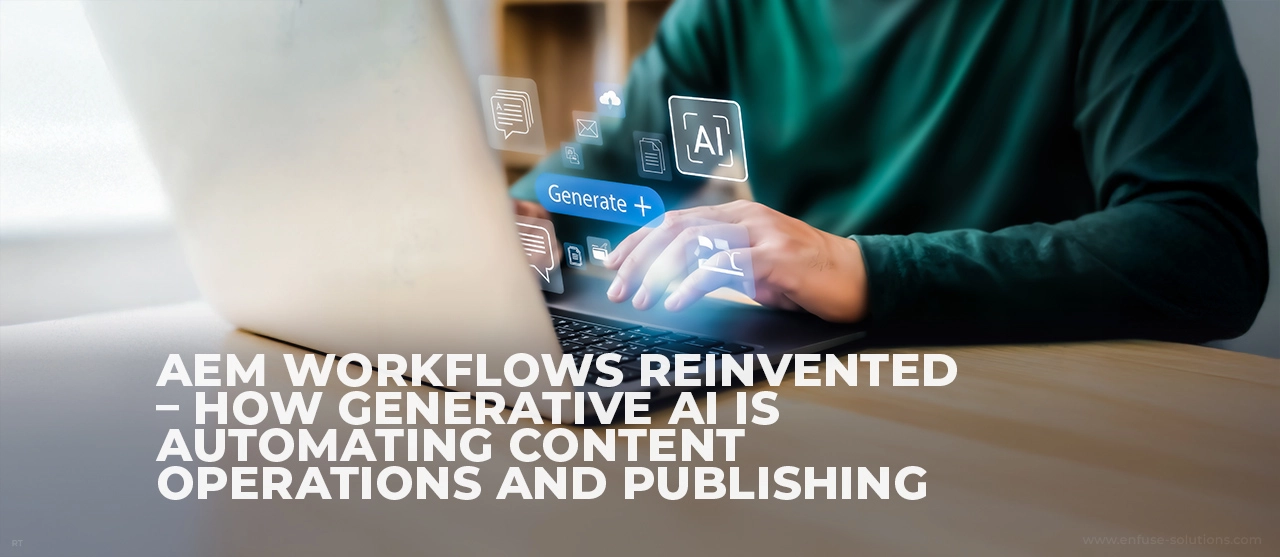
In the rapidly evolving digital landscape of 2025–2026, Generative AI in Adobe Experience Manager (AEM) workflows has become a cornerstone for automating content operations and streamlining publishing processes, enabling enterprises to deliver personalized, high-quality content at scale. This transformative fusion of generative AI, content automation, and AEM Cloud workflows is reshaping digital experience management, boosting efficiency, enhancing user engagement, and accelerating go-to-market velocity.
In this blog, we explore how generative AI is integrated into Adobe Experience Manager workflows, key industry statistics, recent advancements, and the future scope of AI-driven content automation. We’ll also look at how organizations can help businesses harness these technologies for competitive advantage.
The Rise Of Generative AI And Its Impact On Content Operations
The global generative AI market is expanding rapidly. According to Grand View Research, the market for generative AI in content creation was valued at USD 14.8 billion in 2024 and is projected to reach USD 80.12 billion by 2030, growing at a CAGR of 32.5% from 2025 to 2030 — driven by a rising demand for scalable, high-quality content across industries.
As organizations struggle with vast volumes of content and high expectations for personalization, generative AI has shifted from experimental to essential, with 65% of companies now adopting or planning to use generative AI in various operations.
A Wi-Fi Talents report further indicates that 55% of companies using generative AI report increased operational efficiency, and nearly 48% of marketing agencies use AI for content creation. These trends underscore the strategic value of AI when embedded into enterprise content platforms like Adobe Experience Manager (AEM).
Generative AI Capabilities In Adobe Experience Manager
1. AI-Driven Content Generation And Variations
Adobe Experience Manager as a Cloud Service integrates generative AI directly within its editing interfaces, allowing authors to generate content copy and images natively without leaving the platform. This includes:
- Generate Variations: Create multiple versions of a headline, paragraph, or hero image optimized for different audiences or use cases.
- Brand-Aware Content: AI can respect brand tone, terminology, and style guidelines in generated output, ensuring compliance with brand governance.
These capabilities drastically reduce the time spent on manual drafting and variation creation — key bottlenecks in traditional content operations workflows.
2. Smart Tagging And Asset Metadata Automation
In AEM Assets, AI generates smart tags and metadata, which enhances searchability and asset organization at scale. Rather than manually tagging thousands of images or videos, AI analyzes content and attributes meaningful metadata automatically — boosting findability and reuse across teams.
This kind of automation enhances digital asset management workflows, making it easier for content teams to deploy assets in personalized experiences across channels.
3. Personalization And Audience Targeting
Generative AI in AEM isn’t just about content creation — it’s also about relevance. By creating personalized variations based on audience segments, brands can tailor messaging to geographic regions, customer interests, and device types.
Personalized experiences are proven to increase engagement and conversions, and embedding AI within AEM workflows removes friction between content production and audience relevance.
4. AI Assistants And Workflow IQ
AEM’s AI Assistant provides conversational help across tasks — from answering queries to automating repetitive content steps. This “AI copiloting” accelerates onboarding for content creators and allows teams to focus on strategic needs rather than manual content housekeeping.
Real-World Use Cases And Industry Adoption
Beyond Adobe’s native innovations, enterprises are leveraging AI to scale publishing workflows:
- Qualcomm’s adoption of Adobe GenStudio showcases how generative AI can optimize global content supply chains and automate asset resizing, localization, and variation generation at scale.
- AI/R’s WEBJUMP integration uses generative AI to accelerate AEM migrations, modernizing legacy systems and enabling smoother transitions to cloud-native content platforms.
These implementations demonstrate that generative AI in AEM is not limited to authoring — it spans migrations, optimization, and full content lifecycle management.
Challenges And Best Practices In AI-Driven AEM Automation
While the benefits are compelling, integrating generative AI into content workflows isn’t without risks:
1. Security And Prompt Injection Risks
AI systems can be susceptible to prompt manipulation, which may lead to inadvertent generation of malicious or off-brand content. Strong governance, filters, and monitoring are essential.
2. Human Oversight And Quality Assurance
Despite soaring adoption, a significant portion of businesses express concerns about AI accuracy and bias. In marketing contexts, 54% of workers worry about inaccuracies in AI outputs and 59% about bias and data integrity.
To mitigate these challenges, organizations should implement human-in-the-loop review processes, feedback loops, and continuous training of AI models for domain-specific contexts.
Future Scope: What To Expect In 2026 And Beyond
As AI efficacy and enterprise readiness continue to improve, the future of generative AI in AEM workflows points to:
1. End-To-End AI-Powered Content Supply Chains
Enterprise platforms will increasingly automate everything from ideation to publishing and performance measurement — making content operations more scalable and predictable.
2. Enhanced Personalization And Predictive Content
AI will not only generate content but also predict which content will drive engagement using historical data and real-time analytics.
3. Real-Time Multimodal Content Generation
Expect AI to generate adaptive multimedia content — text, image, and video — seamlessly tailored across devices and channels.
4. AI-Augmented Workflows Across Enterprise Functions
As BCG reports, AI can support or automate more than 80% of corporate tasks, particularly content and communication-heavy workflows, freeing up teams for strategic work.
The integration trajectory indicates that content strategies powered by AI will soon become a baseline requirement for digital competitiveness.
EnFuse Solutions: Your Partner In AI-Enabled AEM Excellence
At EnFuse Solutions, we specialize in empowering enterprises with tailored AEM and generative AI integration services that automate content operations, enhance workflow efficiency, and maximize ROI. From AEM Cloud deployments to AI-driven content automation strategies, EnFuse Solutions helps businesses unlock the full potential of next-gen digital experience platforms.
Conclusion
In conclusion, generative AI in AEM workflows is fundamentally changing how organizations approach content operations and publishing — from accelerating production and personalization to optimizing asset management and scaling enterprise experiences. With the generative AI content market forecasted to grow significantly through 2030 and beyond, embedding AI into AEM workflows positions brands for sustained digital success.
Whether you’re launching a content platform, automating publishing workflows, or seeking advanced personalization, EnFuse Solutions offers the expertise to turn these opportunities into reality. Contact us today to future-proof your content operations and lead in the era of AI-driven digital experience.
Tags