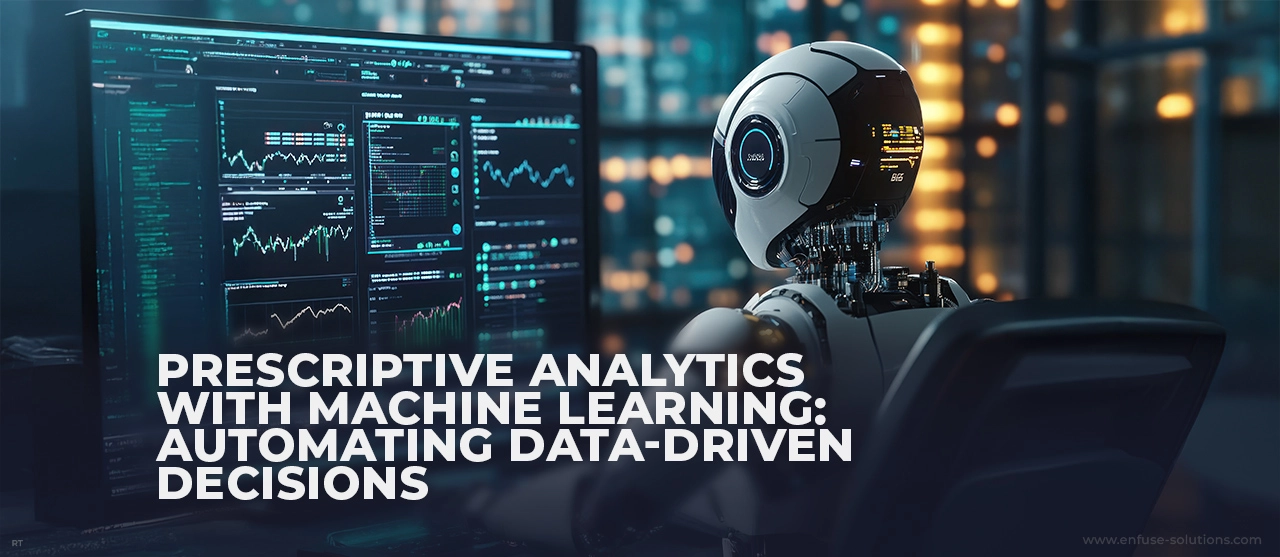
In an era defined by data explosion and digital transformation, organizations no longer merely collect data – they rely on prescriptive analytics combined with machine learning to automate decisions that drive business value. This powerful combination not only tells leaders what happened and what is likely to happen but also what actions to take to help businesses optimize operations, adapt to fast-changing environments, and outperform competitors.
In this blog, we’ll explore the latest statistics, market growth trends, leading advancements, real-world adoption insights, and future scope of prescriptive analytics empowered by machine learning, and why this integration is vital for any analytics-driven enterprise in 2025 and beyond.
Why Prescriptive Analytics And Machine Learning Matter Today
Traditional analytics answered what happened through reports and dashboards. Predictive analytics forecast what might happen using historical trends. But prescriptive analytics goes a step further – recommendation engines suggest specific actions to improve outcomes. At its core are machine learning (ML) models, which learn from data patterns and drive intelligent automation across business processes.
Statistics indicate that ML adoption continues to reshape the analytics landscape:
- The global machine learning market is projected to balloon to as much as US$503.4 billion by 2030, growing at roughly 36% CAGR from 2024, underscoring the rapid uptake of intelligent systems across industries.
- APAC’s machine learning market alone is expected to reach US$38.41 billion in 2025, with a CAGR of over 32% through 2031.
- Roughly 65% of organizations intending to use ML cite its impact on streamlining decision-making processes – a direct enabler for prescriptive analytics.
These figures illustrate a broader industry movement toward intelligent, automated, and real-time decision frameworks.
Market Growth: The Future Is Prescriptive
The prescriptive analytics market itself is experiencing exponential expansion, driven by data complexity, ML integration, and competitive pressure for rapid decisions:
- According to The Business Research Company, the global prescriptive analytics market will grow from US$8.57 billion in 2024 to about US$10.8 billion in 2025, at a ~25% CAGR, and could expand to US$27 billion by 2029.
- Another projection suggests a market of approximately US$44.89 billion by 2035, expanding at nearly 19.1% CAGR between 2025 and 2035.
- Additional forecasts estimate a rise from roughly US$6.9 billion in 2024 to around US$32.4 billion by 2033, with a ~17.8% CAGR, confirming long-term growth.
This rapid expansion reflects increased demand for actionable intelligence, AI-enhanced forecasting, optimization recommendations, and self-learned automation, particularly in sectors like finance, healthcare, retail, logistics, and manufacturing.
How Machine Learning Powers Prescriptive Analytics
ML transforms prescriptive analytics by enabling systems to adapt, learn, and optimize:
1. Automated Decision Support
Machine learning models analyze past and real-time data to recommend:
- Optimal pricing strategies,
- Resource allocation,
- Risk mitigation protocols,
- Customer engagement actions.
This automation accelerates decisions and reduces reliance on manual interpretation of complex datasets.
2. Integration With Operational Systems
ML-driven prescriptive platforms increasingly integrate with ERP, CRM, and IoT networks to:
- Recommend next best actions,
- Trigger automated execution flows,
- Continuously refine models with feedback loops.
This fusion of ML and prescriptive logic allows businesses to scale decision automation across workflows.
3. Real-Time Adaptation
With technologies like edge analytics and streaming ML pipelines, prescriptive systems can produce near-instant recommendations, crucial for:
- Dynamic pricing,
- Fraud detection,
- Supply chain rebalancing.
A growing trend is the deployment of AutoML and self-service BI, making advanced analytics accessible to non-technical business users further accelerating adoption.
Industry Applications & Impact
1. Healthcare
Healthcare providers leverage prescriptive analytics to tailor treatment plans, manage patient churn, and optimize resource utilization, with adoption reaching upwards of ~78% in certain segments for operational insights.
2. Finance
For risk assessment and fraud detection, financial institutions increasingly rely on ML-enhanced prescriptive models, reporting usage growth above 80% in some regions.
3. Retail & E-Commerce
Retailers harness these capabilities to optimize inventory, automate pricing, and deliver personalized experiences – the result often includes 60%+ improvements in customer engagement and conversion rates.
Key Trends Shaping 2025-2026 Analytics Landscape
- AI-Driven Prescriptions: Advances in explainable AI (XAI) and generative models make recommendations more transparent and trustworthy.
- Cloud & SaaS Adoption: Organizations are moving toward cloud-native analytics tools to gain greater scalability and streamline integration speed.
- Edge Analytics: Proximity computing enables real-time recommendations at data sources – reducing latency and driving agile operations.
- Democratized ML: Tools like AutoML enable teams with less technical expertise to build ML-powered prescriptive models, widening enterprise adoption.
- Ethical & Secure Analytics: Compliance with data privacy regulations like GDPR, as well as the need for transparency and explainability, becomes crucial for deploying analytics responsibly.
Challenges On The Road Ahead
Despite its potential, some obstacles persist:
- Data integration complexity across systems often stalls implementation.
- Skill shortages in data science and ML remain a barrier for many organizations globally.
- Balancing privacy with analytics capabilities requires robust security frameworks.
EnFuse Solutions: Accelerating Prescriptive Analytics Transformation
At EnFuse Solutions, they empower businesses to harness the full power of prescriptive analytics and machine learning – from strategy and model development to seamless deployment and ongoing optimization. Our services cover:
- End-to-end analytics architecture,
- ML model creation and automation,
- Real-time data pipelines,
- Scalable cloud and edge analytics solutions.
They help enterprises maximize ROI from data assets and embed decision automation into every facet of operations.
Conclusion: The Future Of Automated Decisions With Prescriptive Analytics And Machine Learning
Prescriptive analytics powered by machine learning is redefining the way organizations make decisions, optimize operations, and innovate in 2025-2026 and beyond. With markets expected to grow at double-digit CAGRs, and ML adoption becoming ubiquitous across sectors, the era of automated, data-driven decision-making is here. Businesses that integrate these advanced analytics capabilities will unlock strategic agility, operational efficiency, and competitive advantage.
Partner with EnFuse Solutions to accelerate your prescriptive analytics journey and transform data into decisive action.
Tags