
As computer vision applications scale across industries, one challenge continues to surface early in every AI initiative: how should you annotate your data?
At first glance, the choice between bounding boxes, polygons, and segmentation may seem technical. In reality, it is a strategic decision – one that directly impacts model accuracy, cost, timelines, and scalability.
At EnFuse Solutions Ltd., we’ve seen organizations struggle not because they lack data, but because they choose the wrong annotation approach for their use case. With platforms like Tagi5, this decision becomes more structured, scalable, and aligned to business outcomes.
Why Annotation Choice Matters
Annotation is the foundation of any AI model. The quality and type of annotation determine how well a model can learn, generalize, and perform in real-world scenarios.
In fact, studies suggest that 60-80% of AI project time is spent on data preparation, including annotation. Making the wrong choice early can lead to:
- Rework and delays
- Increased costs
- Lower model accuracy
- Poor scalability
Choosing the right method ensures that your data is not just labeled – but fit for purpose.
Option 1: Bounding Boxes – Speed And Simplicity
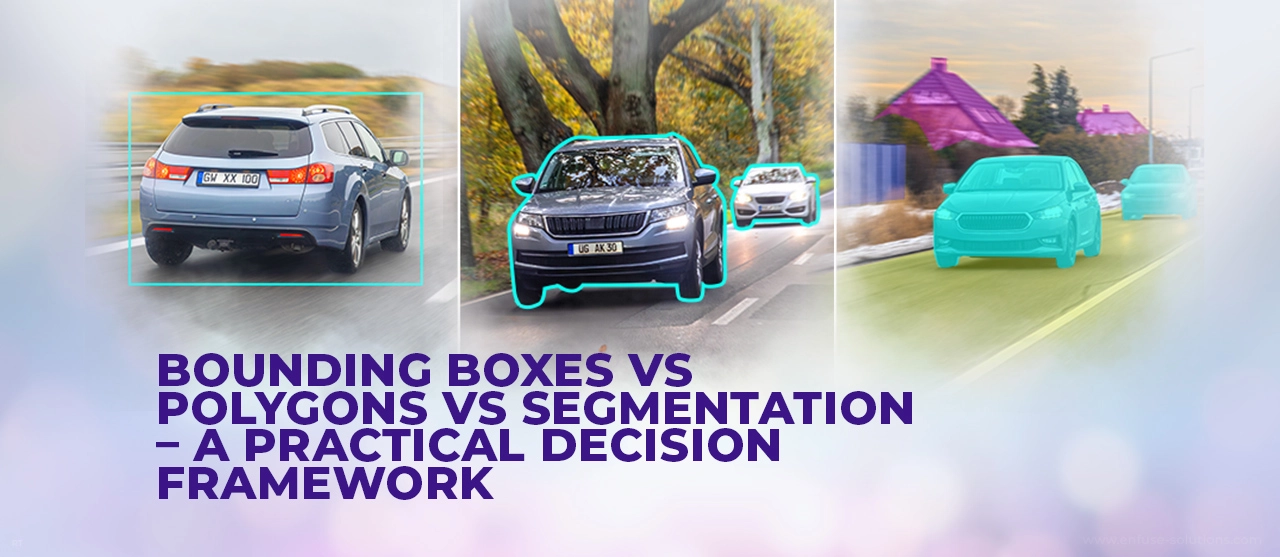
Bounding boxes are the most commonly used annotation method. They involve drawing rectangular boxes around objects of interest.
Best Suited For:
- Object detection tasks
- Large-scale datasets
- Use cases where approximate location is sufficient
Advantages:
- Fast and cost-effective
- Easy to scale across large datasets
- Requires minimal training for annotators
Limitations:
- Low precision for irregular shapes
- Includes background noise within the box
- Limited contextual understanding
Use Cases:
- Retail product detection
- Basic surveillance systems
- Inventory tracking
When To Choose Bounding Boxes:
When speed, scale, and cost efficiency matter more than precision.
Option 2: Polygon Annotation – Precision With Flexibility
Polygon annotation allows annotators to trace the exact outline of an object using multiple points.
Best Suited For:
- Irregularly shaped objects
- Scenarios requiring higher precision
- Mid-level complexity use cases
Advantages:
- More accurate than bounding boxes
- Reduces background noise
- Better representation of object boundaries
Limitations:
- Slower than bounding boxes
- Requires more skilled annotators
- Higher cost per annotation
Use Cases:
- Agriculture (crop and land mapping)
- Construction and infrastructure analysis
- Document layout detection
When To Choose Polygons:
When accuracy is important, but full pixel-level detail is not required.
Option 3: Segmentation – Maximum Precision, Maximum Insight
Segmentation (semantic or instance) labels every pixel in an image, providing the highest level of detail.
Best Suited For:
- Complex environments
- High-stakes applications
- Scenarios requiring deep contextual understanding
Advantages:
- Pixel-level precision
- Enables advanced model capabilities
- Improves performance in complex scenarios
Limitations:
- Time-intensive and expensive
- Requires expert annotators
- Higher computational requirements
Use Cases:
- Autonomous driving
- Medical imaging
- Advanced robotics
When To Choose Segmentation:
When precision and context directly impact outcomes and safety.
A Practical Decision Framework
Instead of asking “Which annotation method is best?”, the better question is:
“Which method is best for my specific use case?”
Here’s a simple way to decide:
- If your priority is speed and scale → Bounding Boxes
- If your priority is balance → Polygons
- If your priority is precision and context → Segmentation
But the real decision often depends on a combination of factors:
- Business objective
- Model requirements
- Budget constraints
- Timeline expectations
- Data complexity
The Hidden Cost Of Getting It Wrong
Choosing an overly simplistic method can lead to poor model performance. Choosing an overly complex one can inflate costs and delay deployment.
In many cases, organizations end up re-annotating datasets, adding weeks or months to project timelines.
This is why annotation strategy should be treated as a design decision, not an operational afterthought.
The EnFuse – Tagi5 Advantage
At EnFuse Solutions Ltd., we help organizations define the right annotation strategy before execution begins, aligning technical choices with business outcomes.
With Tagi5, this strategy is executed through:
- A flexible annotation engine supporting multiple formats
- Domain-trained experts ensuring contextual accuracy
- Scalable workflows for large datasets
- Built-in quality control and governance
This combination ensures that data is not just annotated but optimized for model performance from day one.
Beyond Annotation – Toward Data Intelligence
The future of AI is not just about choosing the right annotation type; it’s about building systems that continuously improve data quality.
By integrating annotation into a broader AI data engine, organizations can:
- Adapt annotation strategies as models evolve
- Improve accuracy through feedback loops
- Scale efficiently without compromising quality
Final Thoughts
Bounding boxes, polygons, and segmentation are not competing methods; they are tools, each suited to different needs.
The key is knowing when to use which.
With the right strategy and the right ecosystem powered by EnFuse Solutions Ltd. and Tagi5, organizations can move faster, reduce costs, and build AI systems that perform reliably in the real world.
Because in AI, better decisions don’t just come from better models – they come from better data, designed with intent.
Tags