Online education has rapidly evolved from convenience to a critical infrastructure. Today, universities, schools, and professional institutions conduct high-stakes assessments remotely – ranging from semester exams to entrance tests and certifications.
While this shift has significantly improved accessibility and flexibility, it has introduced a fundamental challenge: how do you ensure academic integrity in an uncontrolled environment?
Unlike traditional exams conducted in supervised settings, online assessments take place across diverse and unpredictable environments. This opens the door to risks such as:
- Impersonation
- Unauthorized collaboration
- Use of external resources
- Device or browser manipulation
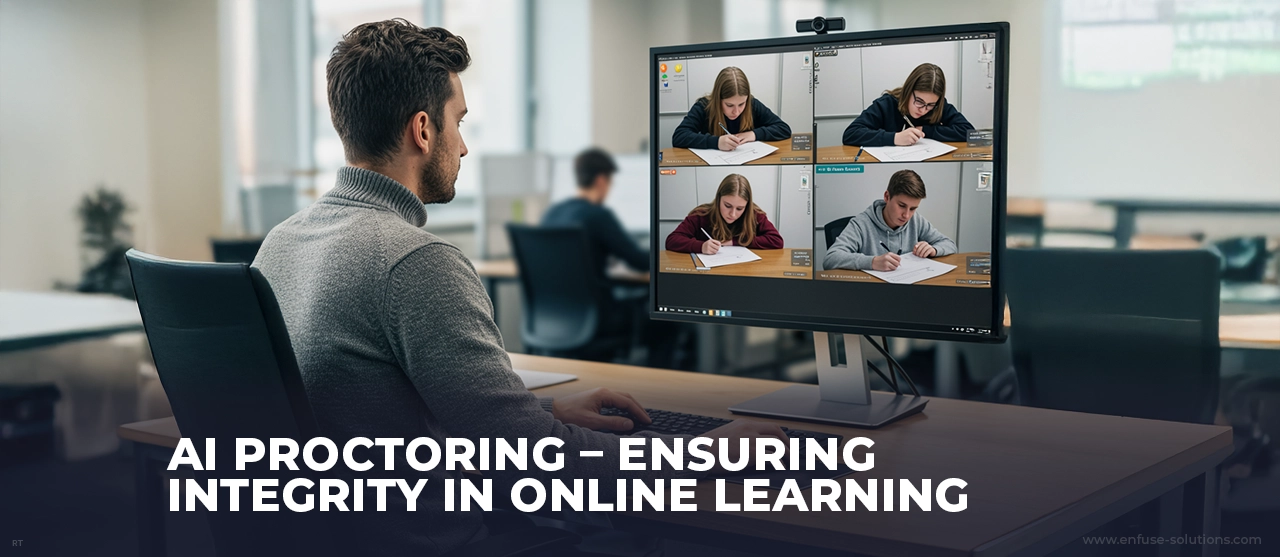
To address this, AI-based proctoring has emerged as a powerful solution – not as a replacement for human oversight, but as a scalable, intelligent framework that enhances fairness, accuracy, and trust.
Limitations Of Traditional Online Proctoring
Early online proctoring solutions attempted to replicate physical invigilation in digital form. These systems relied on basic mechanisms such as webcam monitoring, manual review, and simple rule-based alerts (e.g., “face not visible”).
While functional at a basic level, they present significant limitations:
- Limited scalability for large candidate volumes
- Binary rule systems that fail to capture real-world context
- High false-positive rates, increasing both anxiety and administrative burden
- Uniform enforcement that ignores exam type, duration, and risk level
As assessments scale to thousands or even hundreds of thousands of candidates, these limitations become unsustainable.
AI-Based Proctoring: A Smarter Approach
Modern AI-driven proctoring systems move beyond passive monitoring. They actively analyze behavior, detect anomalies, and flag potential risks similar to how fraud detection systems operate in financial services.
These systems typically integrate multiple layers of intelligence:
- Computer vision for visual analysis
- Audio intelligence for environmental awareness
- Behavioral analytics for pattern recognition
- Identity verification for authentication
- Decision engines for risk scoring
The focus is not continuous surveillance, but event-driven intelligence intervening only when behavior deviates meaningfully from expected patterns.
Key Innovations Powering Modern AI Proctoring
1. Advanced Computer Vision
Modern systems go far beyond simple face detection. They analyze:
- Head orientation and gaze direction
- Presence of additional faces or reflections
- Use of unauthorized devices
- Movement patterns over time
Importantly, these models are designed to distinguish between natural human behavior and suspicious activity, thus reducing unnecessary alerts.
2. Audio Intelligence And Context Awareness
AI now interprets sound contextually rather than treating all noise equally.
Capabilities include:
- Differentiating speech from ambient noise
- Detecting multiple voices
- Identifying persistent or unusual sound patterns
This adds a critical layer of environmental awareness, improving accuracy in real-world conditions.
3. Behavioral Analytics Over Time
Instead of flagging isolated events, modern systems analyze behavioral patterns over time, such as:
- Repeated gaze shifts
- Irregular answer submission behavior
- Mismatch between typing activity and screen interaction
This temporal analysis significantly improves the system’s ability to distinguish between accidental actions and intentional misconduct.
4. Continuous Identity Verification
Authentication is no longer a one-time checkpoint.
AI-based systems now enable:
- ID verification using OCR and forgery detection
- Facial matching with official documents
- Continuous identity validation throughout the exam
This reduces the risk of impersonation – one of the most critical threats in remote assessments.
The Shift To Multi-Agent AI Architectures
A major advancement in AI proctoring is the move toward multi-agent systems.
Instead of relying on a single model, modern platforms deploy specialized AI agents that work together:
- Behavioral Agent – Monitors visual cues like posture, gaze, and environment
- Audio Agent – Detects anomalies such as conversations or suspicious sounds
- Identity Agent – Ensures continuous verification of the candidate
- Decision Layer – Aggregates inputs, assigns risk scores, and determines outcomes
This modular approach improves:
- Accuracy and interpretability
- Scalability for large assessments
- Adaptability to evolving cheating methods
Reducing False Positives: A Critical Focus
One of the biggest concerns in AI proctoring is over-flagging or false positives.
Modern systems address this through:
- Confidence-based thresholds instead of rigid rules
- Multi-signal validation before flagging an incident
- Human review layers for final verification
- Continuous model improvement using feedback
The result is a system that prioritizes accuracy over volume, ensuring that only meaningful incidents are flagged.
Final Thoughts
AI-based proctoring represents a significant shift in how organizations approach digital assessments.
It moves beyond surveillance to intelligent, context-aware monitoring, enabling:
- Scalable exam delivery
- Fair and consistent evaluation
- Strong auditability and compliance
As online education continues to expand, the focus is no longer just on accessibility, it is on trust.
And in this evolving landscape, AI-driven proctoring is not just a solution – it is the foundation for credible, future-ready assessment systems.
The EnFuse Perspective
At EnFuse Solutions Ltd., we believe that trust is the foundation of any assessment system, especially in a digital-first world. AI-driven proctoring is not just about monitoring candidates; it’s about creating a secure, scalable, and fair ecosystem where outcomes are credible and defensible.
By combining advanced AI capabilities with structured workflows and human oversight, EnFuse enables organizations to move beyond fragmented monitoring approaches to intelligent, audit-ready proctoring systems.
Because in the future of digital assessments, success will not be defined by how exams are conducted, but by how confidently their integrity can be upheld.
Tags